- MATERIALS
- Geosynthetics
- Geotextiles
Not sure which geotextile is right for your project?
Main Geotextile Applications
Drainage
Geotextiles act as a conduit to transport fluids within their own plane (particularly thicker non-woven geotextiles or when combined with geonets).
Filtration
The geotextile acts as a barrier that allows water to pass through while retaining fine soil particles. This prevents the migration of fines that could clog surrounding granular materials.
Reinforcement and Stabilization
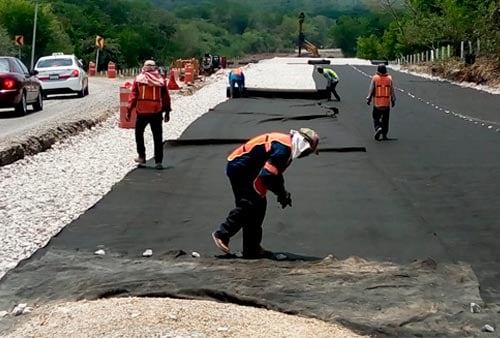
This is the primary mechanical function, where the geotextile improves the load-bearing capacity of the system by absorbing tensile stresses.
Erosion Control
The geotextile protects the soil surface from the kinetic forces of water (rainfall or surface runoff) and wind, which would otherwise dislodge soil particles.

We offer geotextiles certified by top international brands
| Woven Geotextile | Non Woven Geotextile | |
|---|---|---|
| Primary Function | Reinforcement and separation | Filtration, drainage, separation and protection |
| Tensile Strength (ASTM D4595) | High (Ideal for structural loads) | Medium |
| Permeability Normal to the Plane (ASTM D4491) | Medium to low | High |
| Elongation at Break | Low (≤ 15–25 %) | (≥ 40–80 %) |
| Filtration Capacity | Suitable only in well-graded soils | Excellent in fine-grained and poorly-graded soils |
| Behavior Under Cyclic Loading | Good for static loads | Better for dynamic loads |
| Typical Applications | Roads, highways, subgrade reinforcement, retaining walls | Drainage systems, landfills, erosion control, geomembrane protection |
Frequently Asked Questions (FAQS)
What is the difference between woven and non-woven geotextiles?
According to the IGS (International Geosynthetics Society), woven geotextiles are primarily used for reinforcement due to their high tensile strength, while non-woven geotextiles are used for filtration, drainage, and protection thanks to their greater permeability and ability to conform to the soil.
What's the difference between a geomembrane and geotextile?
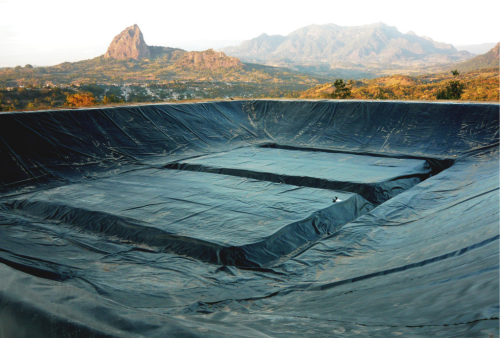
The main difference between geotextiles and geomembranes is their permeability and function: geotextiles are permeable materials designed to filter, drain, and reinforce soils, whereas geomembranes are impermeable barriers whose primary function is liquid containment and environmental protection.
In summary:
- Geotextile: Allows water to pass through while retaining soil particles (filtration and stabilization).
- Geomembrane: Completely prevents fluid seepage (waterproofing for ponds, landfills, and mining applications).
Both are frequently used together to protect the geomembrane from punctures and to improve the system's drainage.
How do geotextiles help with erosion control?
Geosynthetics must primarily comply with ASTM standards (such as D35 and D4439) and ISO standards (series 10318), which regulate their mechanical and hydraulic properties. CE certification is essential for the European market, along with following the guidelines of the GSI (Geosynthetic Institute). In Mexico, they are governed by NMX standards and SCT protocols to ensure their durability and performance.